Official Documents & Reports
- Consumer Confidence Report (CCR)
- Urban Water Management Plan (UWMP)
- Water Conservation Annual Report
- MPWD Policy Manuals
- Water Capacity Charges Update
- Finance Plans & Rate Studies

Since 1929, the MPWD has provided safe, high quality, and reliable water to its customers. We are pleased to report in the 2025 Consumer Confidence Report (CCR) that the MPWD once again met and surpassed all federal and state water quality regulations.
AVAILABLE FOR DOWNLOAD AS PDF
Your satisfaction is our top priority. Please contact us with any questions or concerns.
To view a past CCR, select a year below:
2025 Urban Water Management Plan
The UWMP Act (CA Water Code §§ 10608-10656) requires MPWD to update its UWMP every 5 years

The Mid-Peninsula Water District (MPWD or District) has adopted its 2025 Urban Water Management Plan (UWMP or Plan) and Water Shortage Contingency Plan (WSCP). The UWMP and WSCP will be effective for five years through 2030.
The UWMP is a foundational planning document that includes descriptions of historical and projected water demands, water supplies, and water supply reliability through the year 2050. It includes an assessment the sufficiency of water supplies over different hydrologic conditions, and describes MPWD's actions to promote water conservation and demand management measures. The WSCP outlines the policies and actions MPWD can take to address future water supply shortages due to droughts or other supply interruptions.
DOWNLOAD THE FINAL MPWD 2025 UWMP HERE (PDF)
DOWNLOAD THE FINAL MPWD 2025 UWMP APPENDICES HERE (PDF)
DOWNLOAD THE FINAL MPWD 2025 WSCP HERE (PDF)
Summary of the UWMP
Chapter 1 - Urban Water Management Plan Introduction and Overview
This chapter presents the background and purpose of the UWMP, describes the Plan organization and provides an overview of the Plan. For agencies that rely on water from the Sacramento-San Joaquin Delta (Delta), this chapter also discusses and demonstrates consistency with the Delta Plan by the Delta Stewardship Council. MPWD relies solely on potable water purchased from the San Francisco Public Utilities Commission (SFPUC) Regional Water System (RWS); therefore, this requirement does not apply to its water sources.
Chapter 2 – Urban Water Management Plan Preparation
This chapter discusses key structural aspects related to the preparation of this UWMP, and describes the coordination and outreach conducted as part of the preparation of the Plan, including coordination with local agencies (i.e., the Bay Area Water Supply and Conservation Agency [BAWSCA], the BAWSCA member agencies, the Cities of Belmont, San Carlos and Redwood City, SFPUC, and the County of San Mateo) and the public.
Chapter 3 – Service Area Description
This chapter provides a description of MPWD’s water system and service area, including information related to the climate, population, and demographics. MPWD is located in San Mateo County and serves the City of Belmont and portions of the City of San Carlos, the City of Redwood City, and unincorporated San Mateo County. MPWD serves a population of approximately 31,059 and has a temperate climate. The majority of the 19 inches of average annual precipitation falls between late October and early May. Much of the MPWD service area is “built out,” allowing for only modest population increases in the future assuming continuation of current zoning and densities.
Chapter 4 – Water Use Characterization
This chapter describes and quantifies MPWD’s current and projected demands through the year 2050. MPWD provides drinking water (also referred to as “potable water”) to customers. Water demands refer not only to the water used by customers but also include the water used as part of the system’s maintenance and operation, as well as unavoidable losses inherent in the operation of a water distribution system. Total water demand within MPWD was 844 million gallons (MG) in 2025. Taking into account historical water use, expected population increase and other growth, climatic variability, and other assumptions, water demand within MPWD is projected to increase to 1,280 MG by 2050.
Chapter 5 – SB X7-7 Baselines, 2020 Targets, and 2025 Reporting
In this chapter, the District compares its per capita water use with its water use target for the year 2020. The Water Conservation Act of 2009 (Senate Bill [SB] X7-7) was enacted in November 2009 and required the state of California to achieve a 20% reduction in urban per capita water use by December 31, 2020. In order to achieve this, each urban retail water supplier was required to establish water use targets for 2015 and 2020 using methodologies established by DWR. MPWD achieved its 2020 water use target and remains under the target in 2025.
In July 2024, the State enacted the Making Conservation a California Way of Life (MCCWL) regulation to promote long-term water conservation and drought resilience beyond SB X7-7. MCCWL established annual Urban Water Use Objectives (UWUOs) for water suppliers. UWUO compliance falls under the authority of the State Water Resources Control Board (SWRCB). As such, although UWUO compliance projections are not required as part of a UWMP, they can provide valuable insight into the potential need and timing for additional conservation measures. For this reason, this chapter also documents MPWD’s progress towards meeting the UWUOs. MPWD is expected to be in compliance with its UWUOs through 2050.
Chapter 6 – Normal Year Water Supply Characterization
This chapter presents an analysis of MPWD’s water supplies, as well as an estimate of water-related energy consumption. The intent of this chapter is to present a comprehensive overview of MPWD’s water supplies, estimate the volume of available supplies over a minimum 20-year planning horizon, and assess the sufficiency of MPWD’s supplies to meet projected demands under “normal” hydrologic conditions.
MPWD relies on the SFPUC RWS for all of its potable water supply. MPWD’s contractual allocation to SFPUC supplies (known as its Individual Supply Guarantee [ISG]) is 3.891 million gallons per day (MGD), or approximately 1,420.22 MG. Supplies are anticipated to be sufficient through the year 2050 under normal hydrologic conditions. Wastewater is processed within MPWD’s service area by Silicon Valley Clean Water (SVCW), and 689 MG of wastewater were collected in 2025.
Reporting calculated water system energy intensity is a requirement for the UWMPs. Energy intensity is defined as the net energy used for water treatment, pumping, conveyance, and distribution for all water entering the distribution system. The energy intensity for MPWD is calculated to be 1,366 kilowatt hours per million gallons of water (kWh/MG).
Chapter 7 – Water Service Reliability and Drought Risk Assessment
This chapter assesses the reliability of MPWD’s water supplies, with a specific focus on potential constraints such as water supply availability, water quality, and climate change. The intent of this chapter is to identify any potential constraints that could affect the reliability of MPWD’s supply (such as drought conditions) to support MPWD’s planning efforts to ensure that its customers are well served. Water service reliability is assessed during normal, single dry-year, and multiple dry-year hydrologic conditions.
Based on this analysis, MPWD expects the available supplies to be sufficient to meet projected demands in normal years. However, MPWD could experience significant shortfalls of its SFPUC RWS supplies during single dry and multiple dry year conditions as a result of the Water Quality Control Plan for the San Francisco Bay/Sacramento-San Joaquin Delta Estuary (Bay-Delta Plan Amendment) implementation. At this time, numerous uncertainties remain in the implementation of the Bay-Delta Plan Amendment and the resultant allocation of the available supply to MPWD and the other SFPUC Wholesale Customers.
No water quality issues are expected to affect the quality of water served to MPWD’s customers. Water quality is routinely monitored and MPWD is able to make all appropriate adjustments to its treatment and distribution system to ensure only high quality drinking water is served.
Chapter 8 – Water Shortage Contingency Plan
The District’s Water Shortage Contingency Plan (WSCP) is included as a separate document in Appendix D to the UWMP. The WSCP serves as a standalone document to be engaged in the case of a water shortage event, such as a drought or supply interruption, and defines specific policies and actions that will be implemented at various shortage level scenarios. For example, implementing customer water surcharges, or restricting landscape irrigation to specific days and/or times. Consistent with DWR requirements, the WSCP includes six levels to address shortage conditions ranging from up to 10% to greater than 50% shortages.
Chapter 9 – Demand Management Measures
This chapter includes descriptions of past and planned conservation programs that the District and BAWSCA operate within each demand management measure (DMM) category outlined in the UWMP Act, specifically: (1) water waste prevention ordinances, (2) metering, (3) conservation pricing, (4) public education and outreach, (5) distribution system water loss management, (6) water conservation program coordination and staffing support, and (7) “other” DMMs. MPWD has developed a suite of conservation programs and policies which address each DMM category.
Chapter 10 – Urban Water Management Plan Adoption, Submittal, and Implementation
This chapter provides information on a public hearing, the adoption process for the UWMP and WSCP, the adopted UWMP and WSCP submittal process, Plan implementation, and the process for amending the adopted UWMP and WSCP. Prior to adopting the UWMP and WSCP, MPWD held a formal public hearing to present information on its UWMP and WSCP on July 23, 2026 at 6:30pm. This UWMP and corresponding WSCP were submitted to DWR within 30 days of adoption.
Chapter 11 – References
This chapter contains key references and sources used throughout the Plan.
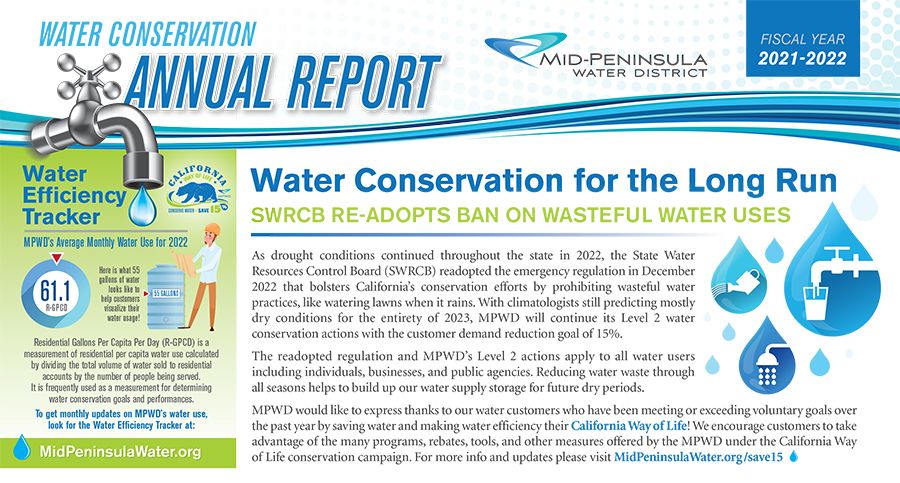
MPWD's Water Conservation Annual Report is a comprehensive accounting of MPWD’s annual efforts, including achievements, rebate programs, reporting on the State Water Resources Control Boards (SWRCB) and Bay Area Water Supply and Conservation Agency (BAWSCA), community outreach and education, and MPWD's own water conservation efforts.
Financial Management Policy Manual
The Mid-Peninsula Water District is governed by the provisions of the California Water Code Sections 30000-33901. This Financial Management Policy will provide a comprehensive guide on the conduct of the MPWD’s financial affairs and is intended to provide an overview of the financial management, accounting, and internal control policies to ensure the MPWD’s compliance with prudent and financial management standards.
Its further purpose is to ensure that MPWD assets are safeguarded, that financial statements are in conformity with Generally Accepted Accounting Principles (GAAP), as established by the Governmental Accounting Standards Board (GASB), and that MPWD follows best practices to ensure finances are managed with responsible stewardship.
Download the MPWD Financial Management Policy Manual here (PDF)
Records Management Policy Manual
It is the policy of the Mid-Peninsula Water District to properly manage the retention and disposition of District records. Proper management of District records ensures prompt and accurate retrieval of records and compliance with legal and regulatory requirements, as well as minimizes the use of District resources for storage of records that are no longer needed.
This policy applies to all District employees, elected or appointed officials, contractors, vendors, temporary personnel, volunteers, or anyone creating or using District records.
Management of District records applies to all records in any format (paper, electronic) or location (on-site, off-site, in District vehicles, on District computers, laptops, tablets, and other electronic devices).
Download the MPWD Records Management Policy Manual here (PDF)
Personnel Manual
The Mid-Peninsula Water District is governed by the provisions of the California Water Code Section 30000 et seq. (and following) sections. Under the Water Code, the MPWD General Manager has authority to employ and discharge an employee at any time, with or without cause.
The language used in the MPWD Personnel Manual is not intended, nor is it to be construed, to constitute a contract between the MPWD and any employee or the public. The MPWD may add, modify, or delete any provision contained in this manual, including those concerning employee benefits, at any time with or without notice.
This Personnel Manual replaces and supersedes all personnel manuals, revisions, and amendments previously adopted by the MPWD.
Download the MPWD Personnel Manual here (PDF)
MPWD Personnel Manual History:
Water Capacity Charges Update
MPWD levies an Existing Facilities Charge on new or expanded connections as a condition of development. This charge was established to recover the cost of capacity in District facilities benefitting new development. The current fee was adopted in 1993 and has not been updated in over 20 years. This report refers to this type of development impact fee as a “capacity charge,” in line with terminology used in California Government Code. New connections also pay a Meter Charge to recover the cost of the water meter and a Service Line Charge to pay for the District’s costs of installing the service line and making the physical connection to the water main.
Water Rate Study (September 23, 2024)
The Study analyzed rates through 2028 and was designed to ensure that the District does not collect more revenue than is necessary to cover MPWD’s costs, and that the rate structure aligns with the proportional cost of providing services.
Download the Water Rate Study here (PDF)
Water Rate Update (May 18, 2018)
Download the complete Water Rate Update here (PDF)
Water Financial Plan & Rate Study (May 26, 2015)
The study develops long‐term financial projections and calculates new water rates designed to equitably recover the costs of providing service. The recommended rates are designed to meet the District’s operational and capital funding needs, comply with legal requirements, and be fair to all customers.
Download the complete Water Financial Plan & Rate Study here (PDF)
Water Finance & Rate Update (April 24, 2016)
A summary of key issues (water consumption and MPWD finances) as part of the ongoing MPWD Financial Plan and Rate Study.
Download the complete update here (PDF)
Ordinance No. 120
An Ordinance Amending Attachment A Regarding Rates and Charges to the Water Service Ordinance for The Mid-Peninsula Water District.