Backflow Prevention & Cross-Connection Control Plan
- General Information
- Single-Family
- Non-Single-Family
Single-Family Customers
Mid-Peninsula Water District’s Cross-Connection Control Plan (PDF) sets requirements for cross-connection control for all MPWD customers, ensuring the water system is protected and safe from potential backflow hazards. While you may not consider your home a risk to the public drinking water system, every home contains some level of hazard. It is the job of the hazard assessments to determine which single-family connections are high hazards so that MPWD can ensure the public water system is protected.
Common hazardous single-family residential cross-connections include:
- Fire sprinkler systems
- Household sewage pumps
- Lawn irrigation systems
- Pools and Spas
- Septic Systems

What to Expect
MPWD is committed to implementing this program in a transparent and customer-focused manner while protecting public health.
Starting Spring 2026, MPWD will begin reaching out to commercial, industrial, institutional, and multi-family residential customers. Due to these connections’ more complex plumbing and higher risk, MPWD’s initial goal is to ensure they are protected by an RP.
Once this goal is met, MPWD will begin using a combined approach to conduct preliminary hazard assessments. Upon completion of the preliminary assessments, MPWD will begin outreach to single-family residential customers:
- Single-family residential service connections found to be hazardous in the preliminary assessment will be asked to install an RP within 90 days of notification.
- All remaining single family residential service connections will be asked to complete MPWD's Hazard Assessment Questionnaire.
- Upon completion of the Hazard Assessment Questionnaire, if further assessment is required, residents will be asked to hire a certified Cross-Connection Control Specialist to complete MPWD's Hazard Assessment Report within 90 days of notification.
- Based upon the questionnaire and assessment report, single-family residential service connections found to be hazardous will be asked to install an RP within 90 days of notification.
In the meantime, MPWD encourages single-family customers to learn more about the Cross-Connection Control Plan (PDF).
Updates, as they become available, will be posted on this page. MPWD will conduct public forums and in-person Q&A sessions throughout the process. Customers may expect additional educational materials and information to be posted on this page and distributed via mailers.
Installation, Maintenance & Testing
MPWD’s backflow prevention assembly installation, maintenance and testing requirements can be found HERE (PDF).
- Test tracking and documentation is currently managed through San Mateo County Environmental Health Services
- Assemblies must be inspected and tested annually by a tester authorized by San Mateo County. NOTE: Testers are listed by the location of their company. Any tester on San Mateo County's approved tester list may be use for testing within MPWD's service area.
Accidents Happen!
Backflow occurrences do happen and have real world health effects! Below are summaries of a few recorded single-family residential backflow events. For commercial and industrial examples, please visit our non-single-family service connection page These examples and more can be found at The American Backflow Prevention Association website.
- Mactier, Ontario: A boil water notice advisory was issued after it was discovered that a contractor had hooked up a domestic sewage pump to the drinking water system.
- Commerce City, Colorado: After a Commerce City home’s water began to smell fishy, a cross-connection between the home’s water and sewer lines was discovered. An investigation found a contractor had accidentally connected the home’s potable water system to their sewage system, while installing a water softening system.
- Corpus Christi, Texas: Utility crews pinpointed the source of E-coli contamination to an unprotected sprinkler irrigation system.
Questions or More Information?
For any questions relating to backflow, backflow prevention assemblies, cross-connections or MPWD’s Cross-Connection Control Plan please email Backflow@midpeninsulawater.org
We can also be reached by phone, Monday through Thursday 7:30am-4:00pm at (650) 591-8941
Frequently Asked Questions (FAQs)
Backflow is the unintended reversal of water flow that can allow contaminants from private plumbing systems to enter the public drinking water system. It can occur when water pressure drops due to events such as a water main break or firefighting activity. Preventing backflow helps protect public health and maintain safe drinking water for the entire community.
Real world threats to the public water supply are more common than you would think. While not every home is a high-hazard environment, many homes do contain high-hazard cross-connections. Simple everyday items like irrigation systems, fountains, and pools can pose threats to our water if left unprotected. Without a hazard assessment, it is impossible to accurately assess the threat a service connection poses to the public drinking water system.
Backflow protection takes many forms. However, to ensure our public drinking water system is adequately protected, MPWD is requiring an RP downstream of the water meter. If you already have an RP installed, it will be located between the water meter and the building shutoff valve. View the section titled "What is an RP?" For further assistance with identifying an RP. If you are still unsure if you have an RP installed on your water line, please contact San Mateo County either by phone at (650) 372-6250 or by email at envhealth@smcgov.org
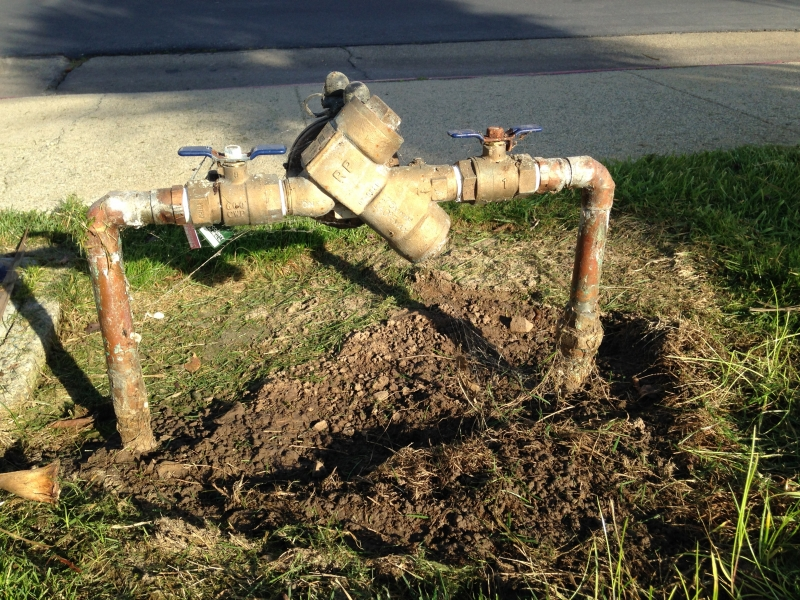
A backflow prevention assembly consisting of a relief valve, located
between two check valves that are located between two shutoff valves,
with four properly placed test cocks. More broadly speaking, an RP is a
testable, mechanical assembly designed to prevent backflow. It provides
the greatest level of protection offered by a backflow prevention
assembly. RPs vary in make, model and size; an example of what an RP
could look like is pictured below.
Good work, you are ahead of the curve! Thanks for proactively protecting the public drinking water system. Please indicate that you already have an RP when we send out the Hazard Assessment Questionnaire. Ensure your device is tested annually by a certified backflow prevention assembly device tester. Reach out to San Mateo County, either by phone at (650) 372-6250 or by email at envhealth@smcgov.org, if you have any questions regarding backflow prevention assembly testing.
Backflow prevention assemblies are mechanical assemblies that can wear out, become damaged, or fail over time due to freezing, debris, or plumbing changes. Annual testing by a certified tester helps ensure the assembly will function properly if a backflow event occurs and continues to protect the drinking water system.
No. Not every property requires a backflow prevention assembly. Requirements are based on a hazard assessment that considers property type, plumbing configuration, and how water is used. Many single-family homes are considered low risk, while commercial, industrial, and multi-family systems require additional protection.
MPWD uses a hazard-based evaluation process that may include record reviews, questionnaires, and, in some cases, on-site inspections conducted by certified professionals. Properties are categorized as having no hazard, low hazard, or high hazard. Required backflow protection is based on this evaluation.
When a backflow prevention assembly is required, installation, testing, and maintenance are typically the responsibility of the property owner, similar to other private plumbing components. MPWD is committed to clear communication, reasonable timelines, and coordination with certified professionals when requirements apply.
No. MPWD is currently focused on education and planning. Any future requirements for installation, upgrades, or testing will be communicated clearly and well in advance. The District is committed to a phased, customer-focused approach that prioritizes public health while minimizing disruption.
Customers are encouraged to contact MPWD’s cross-connection control program coordinator at Backflow@midpeninsulawater.org or (650) 591-8941 for property-specific questions or general information.